Sequencer API设计文档
本文档讨论"生成分布式唯一(自增)id"的API
1. 需求
1.1. 生成全局唯一id
Q: 什么时候需要生成全局唯一id?
A: db不帮你自动生成的时候。比如:
- db做了分库分表,没帮你自动生成id,你又需要一个全局唯一的业务id
- 没走db,比如请求到了后端要生成一个traceId
1.2. 对该id有递增的需求。具体来说有很多种:
- 不需要递增。这种情况UUID能解决,虽然缺点是比较长。本API暂时不考虑这种情况
- “趋势递增”。不追求一定递增,大部分情况在递增就行。
Q: 什么场景需要趋势递增?
-
对b+树类的db(例如MYSQL)来说,趋势递增的主键能更好的利用缓存(cache friendly)。
-
拿来排序查最新数据。比如需求是查最新的100条消息,开发者不想新增个时间戳字段、建索引,如果id本身是递增的,那么查最新的100条消息时直接按id排序即可:
select * from message order by message-id limit 100
这在使用nosql的时候很常见,因为nosql在时间戳字段上加索引很难
-
sharding内单调递增。比如Tidb的自增id 能保证单台服务器上生成的id递增,没法保证全局(在多台服务器上)单调递增
-
全局单调递增
希望生成的id一定递增,没有任何倒退的情况。
1.3. 可能会有自定义id schema的需求
比如要求id的格式为"前8位是uid,后8位是自增id"这样的需求
1.4. 可能有信息安全相关需求
如果ID是连续的,恶意用户的扒取工作就非常容易做了,直接按照顺序下载指定URL即可;
如果是订单号就更危险了,竞对可以直接知道用户一天的单量。所以在一些应用场景下,会需要ID无规则、不规则。
2. 产品调研
| 系统 | 能否保证生成的id唯一 | 趋势递增 | 严格递增 | 可用性 | 信息安全 |
|---|---|---|---|---|---|
| 单机redis | yes.需要特殊配置redis服务器,把两种落盘策略都打开、每次写操作都写磁盘 ,避免丢数据 | yes | yes.前提是宕机重启不丢数据 | 有单点故障风险 | |
| redis 主从复制+sentinel | no.复制是异步的,即使用Wait命令等待同步复制还是可能在fo后丢数据,见文档 | yes | 取决于会不会丢数据 | ||
| redis cluster | 同上 | yes | 同上 | ||
| snowflake | no.(时钟回拨等情况可能导致id重复;需要依赖外部存储;或者声明必须关闭NTP或使用防止回拨的可靠NTP) | yes | no | good | |
| Leaf snowflake | yes | yes | no | good | |
| Leaf segment | yes | yes | no | ||
| Leaf segment只部署一台Leaf服务器 | yes | yes | yes | 有单点故障风险 | |
| zookeeper | yes | yes | yes | ||
| etcd | yes | yes | yes | ||
| mysql单库单表 | yes | yes | yes | 有单点故障风险 |
3. grpc API设计
3.1. proto定义
// Sequencer API
rpc GetNextId(GetNextIdRequest )returns (GetNextIdResponse) {}


message GetNextIdRequest {
  string store_name = 1;
  // key is the identifier of a sequencer.
  string key = 2;

  SequencerOptions options = 3;
  // The metadata which will be sent to the component.
  map<string, string> metadata = 4;
}

// SequencerOptions configures requirements for incremental and uniqueness guarantee
message SequencerOptions {
  enum AutoIncrement {
    // WEAK means a "best effort" incrementing service.But there is no strict guarantee
    WEAK = 0;
    // STRONG means a strict guarantee of global monotonically increasing
    STRONG = 1;
  }

//  enum Uniqueness{
//    // WEAK means a "best effort" unqueness guarantee.
//    // But it might duplicate in some corner cases.
//    WEAK = 0;
//    // STRONG means a strict guarantee of global uniqueness
//    STRONG = 1;
//  }

  AutoIncrement increment = 1;
//  Uniqueness uniqueness=2;
}

message GetNextIdResponse{
  int64 next_id=1;
}
解释:
其实就一个GetNextId接口,需要传key作为命名空间(比如传某个订单表表名,"order_table"),sequencer保证生成的id在该命名空间内唯一、递增。
SequencerOptions.AutoIncrement用于声明用户对递增性的需求,是趋势递增(WEAK)还是要求严格全局递增(STRONG)
Q: 是否由Layotto帮用户按需拼id?
A: API和Layotto运行时不管这事,由sdk或者用户自己处理,或者某个特殊组件想实现这个feature也可以。
Q: 返回类型是string还是int64
如果返回string,假如用户用了某个返回int64的实现,在用户代码中把返回的string转成了int64,那他迁移到别的组件,这个转换过程可能报错
如果返回int64,组件就没法帮用户做一些定制拼id的事情了
为了可移植性,选择int64。拼id的事情在sdk里做
Q: int64溢出问题怎么处理?
暂不考虑
3.2. 关于唯一性的争议
API中原先定义了用户传参SequencerOptions.Uniqueness枚举值 ,其中WEAK代表"尽量保证全局唯一,但是极小概率可能重复",要求业务代码如果拿到id去写库时,做好id重复、重试的心理准备;而STRONG代表严格全局唯一,用户代码不考虑id重复、重试之类的事情。
- 定义这个枚举值的原因(好处)
如果要保证严格唯一,组件实现起来会比较重。比如单机redis常用的落盘策略就不行,可能导致宕机重启之后丢数据、生成一个重复id;比如直接在sidecar里写一个snowflake算法就不行,因为可能会有时钟回拨导致id重复的问题(NTP时钟同步、闰秒等情况都有可能导致时钟回拨)。Leaf的snowflake实现 依赖zookeeper判断时钟回拨;
- 定义这个枚举值的缺点
给用户带来更多理解成本
- 结论
存在争议,本期先不添加该枚举值。默认返回的结果一定能保证全局唯一(STRONG)。
4. 组件API
package sequencer

type Store interface {
	// Init this component.
	//
	// The number 'BiggerThan' means that the id generated by this component must be bigger than this number.
	//
	// If the component find that currently the storage can't guarantee this,
	// it can do some initialization like inserting a new id equal to or bigger than this 'BiggerThan' into the storage,
	// or just return an error
	Init(config Configuration) error

	GetNextId(*GetNextIdRequest) (*GetNextIdResponse, error)

	// GetSegment returns a range of id.
	// 'support' indicates whether this method is supported by the component.
	// Layotto runtime will cache the result if this method is supported.
	GetSegment(*GetSegmentRequest) (support bool, result *GetSegmentResponse, err error)
}

type GetNextIdRequest struct {
	Key      string
	Options  SequencerOptions
	Metadata map[string]string
}

type SequencerOptions struct {
	AutoIncrement AutoIncrementOption
}

type AutoIncrementOption string

const (
	WEAK   AutoIncrementOption = "weak"
	STRONG AutoIncrementOption = "strong"
)

type GetNextIdResponse struct {
	NextId int64
}

type GetSegmentRequest struct {
	Size     int
	Key      string
	Options  SequencerOptions
	Metadata map[string]string
}

type GetSegmentResponse struct {
	Segment []int64
}

type Configuration struct {
	BiggerThan map[string]int64
	Properties map[string]string
}
Q: BiggerThan字段是啥?
要求组件生成的所有id都得比"biggerThan"大。
设计这个配置项是为了方便用户做移植。比如系统原先使用mysql做发号服务,id已经生成到了1000,后来迁移到PostgreSQL上,需要配置biggerThan为1000,这样PostgreSQL组件在初始化的时候会进行设置、强制id在1000以上,或者发现id没法满足要求、直接启动时报错。
Q: BiggerThan为啥是个map?
因为每个key可能有自己的biggerThan.
比如原先app1做了分库分表、用某种发号服务来生成订单表和商品表的id,订单表id达到了1000,商品表id达到2000.
后来app1想换个存储做sequencer,那么他要声明订单表id在1000以上,商品表id在2000以上。
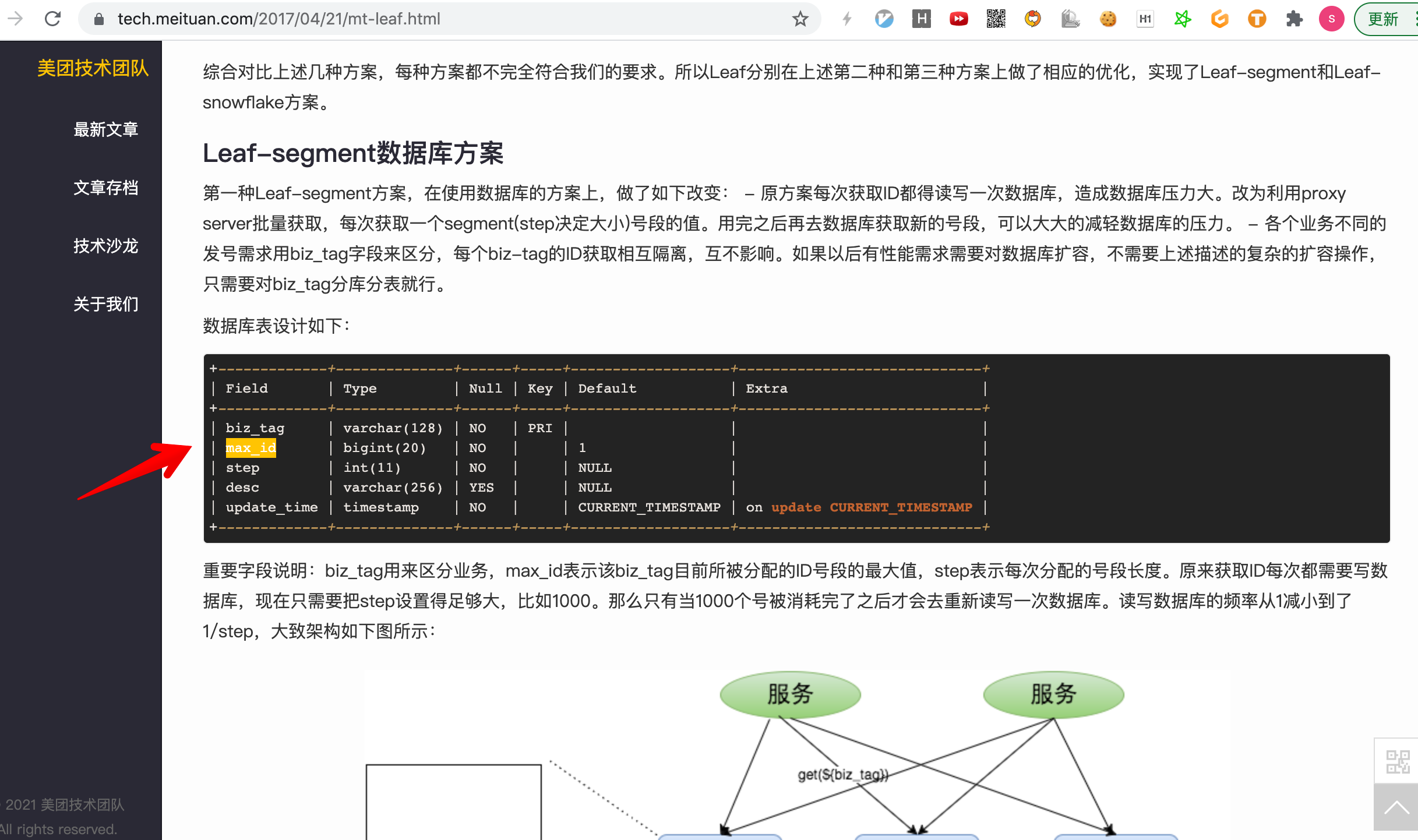
另一个例子是Leaf的设计 ,也是每个biz_tag对应一个max_id(Leaf的max_id就是我们的biggerThan)
Q: 要不要在runtime层实现缓存?
如果runtime做缓存,需要组件实现方法:
GetSegment(*GetSegmentRequest) (support bool, result *GetSegmentResponse, err error)
可以先定义接口,组件先不实现,以后有性能需求再实现